This post contains affiliate links. If you buy through one I may earn a small commission at no cost to you.
There is a moment in every small apartment, usually around the time the boxes are unpacked, when you realize the furniture is the problem. Not the size of the place, the furniture. A full couch, a coffee table, a dining set, a bed, a dresser, all the things a normal apartment owns, and suddenly there is nowhere to walk and nowhere to put the laundry basket down. The square footage was never going to change. What changes everything is buying furniture designed to give the floor back.
Space-saving furniture is not about tiny versions of everything. It is about pieces that do two jobs instead of one, fold away when you are done, climb the wall instead of sprawling across the floor, or hide storage inside themselves. Learn to shop for those four traits and a small apartment stops feeling crowded. Below are the categories worth your money, what each one solves, and what to look for so you buy the good version and not the gimmick.
The short version: stick to furniture that gives back more floor than it takes. A convertible sofa covers seating and a bed, a drop-leaf or wall-mounted table shrinks between uses, nesting and folding pieces disappear when you are done, a storage bed or ottoman swallows the closet you do not have, and tall narrow pieces climb the wall to keep the floor clear. Buy fewer, smarter pieces and leave room to live.
The most valuable space-saving furniture refuses to do just one thing, because in a small apartment every item that does two jobs is a second item you never have to find floor for. The headline buy here is a convertible or sleeper sofa, a couch all day and a bed at night, which alone can let a one-room apartment host guests without owning a guest room. The good ones have ditched the lumpy fold-out and the metal bar you used to feel through the mattress. When you shop, the part to test is the mechanism, since a smooth pull-out or a sturdy click-clack frame beats thin foam folded in half every time, and a hinge that already feels loose in the showroom is the first thing that will fail at home.
A storage ottoman is the small-scale version of the same idea, and if you only buy one space-saving piece, make it this one. A single cube gives you a coffee table when you set a tray on it, a footrest, a seat when company shows up, and a deep bin for blankets and clutter. What separates a good one from a padded box is the lid, so look for a firm, flat top that does not sag in the middle and a hinge or gas strut that holds it open instead of dropping on your hand. A daybed pulls a similar shift in a home office or spare room, working as a sofa by day and a guest bed at night, and the versions with a pull-out trundle underneath sleep two without claiming any more floor.
Furniture that folds or collapses
Folding furniture is a small apartment’s best friend because it only takes up room while you are actually using it, and the rest of the day it flattens out of the way. A drop-leaf or folding dining table lives as a narrow console against the wall most of the week and opens up to seat four on the nights you actually need it, so a table you use for one hour is not eating floor for the other twenty-three. The number that matters on the tag is the folded depth, since a leaf that still juts eight inches into the walkway defeats the purpose.
A set of folding chairs that hang on a hook or slide behind a door covers the seats you only need when guests show up. And if you work from home and the desk is the piece with no room, a wall-mounted folding desk drops down when you need it and folds flat when you do not, though it is the one item here that usually wants a few screws into the wall, so check your lease before you commit to it.
Nesting and stackable pieces
Furniture that tucks into itself stores small and expands on demand, which is exactly the flexibility a tight footprint needs. Nesting tables slide together into one small footprint and pull apart into two or three surfaces when you need somewhere to set drinks, then collapse back down when the evening is over. Stackable stools give you extra seating that stores in a single column in a closet or corner.
When you shop these, weight and stability are what separate the useful from the wobbly. Look for nesting tables with a solid metal or wood frame rather than thin particleboard, since the smallest table in the set takes the most abuse, and pick stools rated to hold a full-grown adult that stack flat without scratching each other. A set that scales from one person to five is only worth owning if the little pieces feel as sturdy as the big one.
Storage built into the furniture
In a small apartment short on closets, the smartest move is to make the furniture you already need carry the storage too. A storage bed frame with built-in drawers, or a platform tall enough for bins underneath, turns the dead space below your mattress into drawer room you would otherwise never have. If you already love your frame, a set of low rolling under-bed storage bins reclaims the same space for a fraction of the cost.
A storage bench by the door or at the foot of the bed seats you while it swallows shoes, linens, or seasonal stuff, and a lift-top coffee table rises to couch height for working or eating and hides a compartment underneath. The point is to make the furniture you were going to buy anyway carry your clutter too, rather than adding a separate dresser or trunk to do it. More of this, room by room, lives in our small apartment storage ideas guide.
Furniture that climbs instead of sprawls
When the floor is spoken for, the smart furniture goes up. Two tall, narrow bookcases hold more than one wide low unit and pull the eye up, which makes the ceiling feel higher and the room feel less crowded. The same logic governs the bed in the tightest spaces, where a loft bed lifts the mattress overhead and frees the whole floor beneath it for a desk or a sofa, and a murphy bed folds flat to the wall during the day.
A slim bathroom etagere that stands over the toilet tank is the same idea in the one room everyone forgets, claiming vertical space that was doing nothing. Vertical furniture is some of the most underused space-saving you can buy, because we plan apartments as floor plans and forget the walls go up eight or nine feet, mostly empty.
Slim, apartment-scale proportions
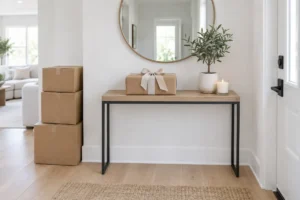
Some pieces save space simply by being built to the right size, and choosing apartment-scale versions of the basics keeps a room from feeling stuffed. An apartment-size sofa is designed with a smaller footprint and a lower back than a standard couch, so it fills its wall without walling off the room. A narrow console table behind the sofa or along an entry adds a surface and storage with only a few inches of depth.
When you shop, the measuring tape matters more than the price tag. A piece scaled to a normal living room lands like a parked car in a small one, so look for compact, shallow-depth versions, and pieces on visible legs, since a few inches of floor showing underneath makes everything read lighter than a piece that sits flat on the ground in a solid block.
The space-saving pieces worth buying
Six pieces, one for each space-saving trait above. Most are freestanding, the kind you can move on your own come cleaning day, and only the fold-down desk asks for a few screws. Prices are rough street ranges, not live quotes.
What to check before you buy anything
Space-saving furniture lives or dies on a few numbers, so measure before you order and spare yourself a return shipment and a wrenched back. Check your doorway, hallway, and any turns, because a couch that fits the room is no use if it will not fit through the door. Measure the open footprint of anything that folds or pulls out, so a sleeper pulled out flat or a table opened for dinner does not end up halfway across the kitchen. Note your ceiling height for anything vertical, and map the walking path you need to keep clear from the door to the bathroom, which is the floor furniture is not allowed to claim.
One caveat on the tall stuff if you rent. A few bookcases and loft frames come with a little anti-tip strap that wants one screw into a stud, so if your deposit hinges on leaving zero holes, read the model details before you order and keep everything else standalone. That keeps your furniture squarely in renter-friendly decor territory rather than something you have to argue with a landlord about.
Frequently asked questions
What is the best space-saving furniture for a small apartment?
Start with the pieces that do two jobs at once. A convertible sofa that becomes a bed, a storage ottoman that doubles as a coffee table and a hidden bin, a drop-leaf table that shrinks between meals, a storage bed that swallows your closet, and tall narrow shelving that climbs the wall cover most of a small apartment’s needs. Anything that only does one thing has to really earn the floor it sits on.
How do I fit furniture in a small apartment?
Start with the biggest pieces, the bed and the sofa, and choose versions that fold, convert, or store. Then add only furniture that earns its space twice, and measure the open footprint of anything that extends so a pulled-out sleeper or opened table still leaves a clear walking path. Keep the floor as clear as you can, since the open floor you can see is what makes a room feel bigger.
Is multifunctional furniture worth it?
For a small apartment, usually yes, because the real payoff is the floor you save more than the money you spend. A sleeper sofa or storage ottoman costs a little more than a single-purpose version but replaces a second piece of furniture entirely, which is a bigger win in a tight space than the price difference. Buy the well-made version, though, since a flimsy convertible mechanism is the one place cheaping out shows fast.
What furniture saves the most space in a studio?
A bed that converts or lifts away saves the most, since the bed eats more floor than anything else you own. After that, a folding or drop-leaf table, a storage ottoman, and tall vertical shelving free the most floor. For a layout built entirely around this, our studio apartment furniture guide walks through the specific pieces a single room needs.
How do I choose furniture for a small space without overcrowding?
Buy fewer pieces and measure everything first. Pick five or six that each do two jobs rather than a dozen single-use ones, choose apartment-scale and leggy versions so the floor stays visible, and leave deliberate open space between pieces. The empty floor is not wasted, it is the thing that keeps a small room from feeling crammed.
Buy less, choose better
Furnishing a small apartment is not about finding miniature versions of everything, it is about buying the few pieces that work two jobs each and skipping the rest. The sofa that opens into a bed, the ottoman hiding your blankets, the table that vanishes after dinner, the shelves that climb the wall the floor could not spare. Get those right, keep them standing on their own so nothing has to bite into a wall you rent, and leave real room to walk between them. Do that and a small apartment stops feeling like a place you got squeezed into and starts feeling like one you furnished on purpose. For the rest of the picture, room by room, head back to our small apartment decorating ideas guide.
Get the renter's first-apartment checklist
Small-space decor ideas for renters, straight to your inbox.
How to organize a small rental closet in five zones with no drilling: double the rod, reclaim it with slim hangers, work the door, divide the shelf, and claim the floor.
Peel-and-stick crown molding adds high-end ceiling trim to a rental with no saw, no nails, no miter cuts. Six picks that hold and an install walkthrough.
This post contains affiliate links. If you buy through one I may earn a small commission at no cost to you. You took a shower in the rental bathroom, walked out to brush your teeth, and noticed the seam above the toilet. The roll you put up six weeks ago, the one that looked perfect…
Christmas decor for a small rental that hangs without nails and comes down in one evening: lights, cabinet bows, garland, the front door and the balcony.
Japandi marries Japanese restraint to Scandinavian warmth, and a small rental is the easiest place to pull it off.
Manage Consent
To provide the best experiences, we use technologies like cookies to store and/or access device information. Consenting to these technologies will allow us to process data such as browsing behavior or unique IDs on this site. Not consenting or withdrawing consent, may adversely affect certain features and functions.
Functional
Always active
The technical storage or access is strictly necessary for the legitimate purpose of enabling the use of a specific service explicitly requested by the subscriber or user, or for the sole purpose of carrying out the transmission of a communication over an electronic communications network.
Preferences
The technical storage or access is necessary for the legitimate purpose of storing preferences that are not requested by the subscriber or user.
Statistics
The technical storage or access that is used exclusively for statistical purposes.The technical storage or access that is used exclusively for anonymous statistical purposes. Without a subpoena, voluntary compliance on the part of your Internet Service Provider, or additional records from a third party, information stored or retrieved for this purpose alone cannot usually be used to identify you.
Marketing
The technical storage or access is required to create user profiles to send advertising, or to track the user on a website or across several websites for similar marketing purposes.