This post contains affiliate links. If you buy through one I may earn a small commission at no cost to you.
Look up. In most small apartments the one piece of square footage nobody uses is the air above your head, a good three or four feet of empty room between the top of your furniture and the ceiling. A loft bed is how you cash that in. It puts the mattress up high and hands the floor underneath back to you for a desk, a couch, a closet, or just somewhere to stand without your knees touching the bed frame.
The version most people remember is the rickety dorm bunk that swayed when you rolled over. Adult loft beds are a different animal. They come in full and queen sizes, hold real weight, climb on actual stairs instead of a wall ladder, and look like furniture rather than camp gear. Below are the loft bed ideas worth knowing for a small apartment, including what to do with the space you just opened up and how to make one work in a rental.
The short version: a loft bed turns one footprint into two floors. Decide what lives underneath before you buy, since a desk, a sofa, and a storage wall each need a different bed height. Measure your ceiling first, pick a model rated for adult weight, and choose stairs over a ladder if you ever plan to make the bed or climb up half asleep.
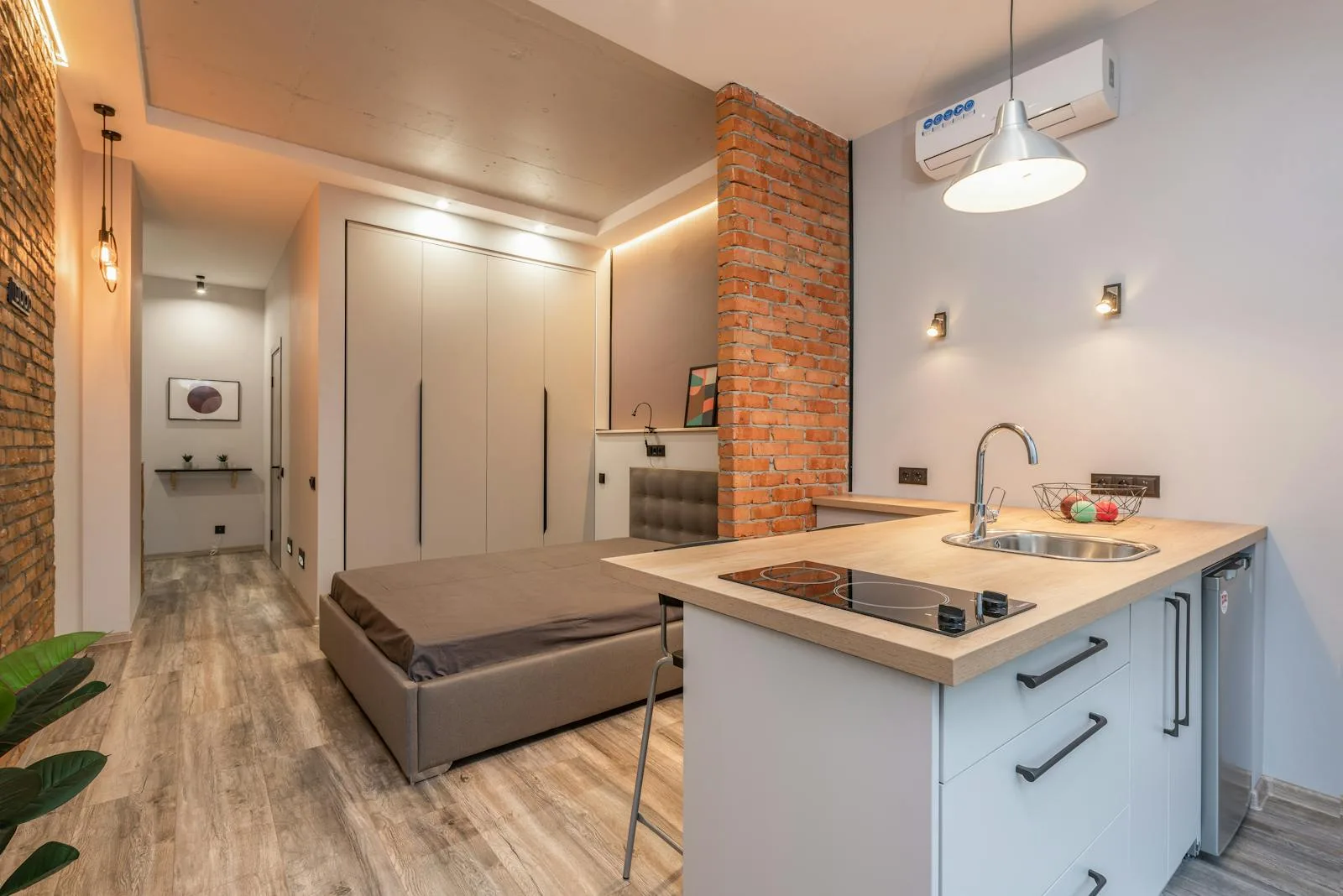
A bed is the greediest thing in a small apartment. It takes the most floor and gives the least back, sitting idle every hour you are awake. A loft bed stacks your day and your night in the same square footage, which is the same multi-use logic that runs through our whole studio apartment ideas guide, just turned vertical instead of horizontal.
The trade is height for floor. You give up headroom over the bed, which you only need lying down anyway, and in exchange you get back a full mattress worth of usable floor underneath. In a studio that floor is often the difference between fitting a workspace and working from the edge of your mattress. It is the same problem a murphy bed solves by folding away, except a loft bed keeps the floor free all day without anything to fold.
Loft bed ideas by what goes underneath
The whole point of a loft is the room you create below it, so the best way to choose one is to decide what that room does.
The most popular setup by far is the office. A loft bed with a desk built into the frame gives you a genuine work-from-home station tucked under the mattress, which means your laptop never has to share a surface with your dinner. If you want the desk to feel like its own room, hang a curtain across the front of the loft so the workspace reads as separate the moment you sit down.
If you would rather lounge than work, leave the space open for a small sofa or a pair of chairs. A loft bed over a compact loveseat turns the area under your mattress into a living room, which is a real luxury in a studio where the bed usually swallows any chance of a seating zone. Keep the loft on the higher side here so you are not ducking every time you stand up from the couch.
For a renter drowning in stuff, the answer is storage. A loft bed with stairs often hides drawers inside each step, and the open bay underneath swallows a clothing rack, a dresser, or stacked bins with room to spare. Framing the underside with shelving turns the whole structure into a closet you happen to sleep on top of, which pairs well with the vertical thinking in our small apartment storage ideas guide.
And if your studio is truly tiny, the simplest idea wins: leave the space underneath open and let it breathe. A clear stretch of floor where a bed would normally sit makes the whole room feel bigger, even with nothing on it.
Adult loft beds versus the dorm version
The childhood loft bed and the grown-up one are not the same product in different sizes, and the gap between them is where both the money and the safety live.
A real adult loft starts with the weight rating. You want a frame built to hold two adults and a mattress, so look for a steel or solid-wood full or queen loft bed with a clearly stated adult weight capacity rather than the lightweight tube-metal twin aimed at dorms. Heavier gauge metal and thicker posts are what stop the sway everyone remembers.
Height is the other split. A high loft maxes out the floor below and suits a tall ceiling. A low loft sits closer to the mattress and works when your ceiling is standard or you simply do not want to climb a flight every night. Match the height to your ceiling and to whatever is going underneath.
Making a loft bed renter-friendly
Good news for renters: a freestanding loft bed needs nothing bolted to your walls. The frame is self-supporting, it rests on the floor, and you take it apart and move it when the lease ends, no patching required. That puts it firmly in renter-friendly decor territory alongside the freestanding furniture we lean on everywhere else.
The real rental constraint is not the landlord, it is the ceiling. Before you fall for any model, measure from your floor to your ceiling and subtract the bed height, then make sure you have enough clearance to sit up in bed without cracking your head. A useful rule of thumb is to leave at least two and a half to three feet of air between the top of the mattress and the ceiling. If your apartment has the high ceilings older buildings sometimes do, a loft is a gift. If you have the low eight-foot ceilings of a newer build, measure twice and lean toward a low loft.
One more renter note: lofts can amplify sound and movement, so a non-slip mat under the feet keeps the frame from walking or squeaking on a hardwood floor, which your downstairs neighbor will quietly thank you for.
What to check before you buy a loft bed
A loft is a real structure you climb on every day, so a few checks save you from a wobbly, regret-filled purchase:
Ceiling height against the bed height plus your sitting-up room, measured before anything else.
Weight rating, stated for adults, with the mattress weight included in your math.
Mattress depth the rails are built for, since a too-thick mattress sits above the guardrail and stops being safe.
Access, stairs versus ladder. Stairs cost floor but are far easier to climb tired or carrying laundry, while a ladder saves space but gets old fast.
Stability, which comes from heavier materials and a wider footprint. Read reviews for the word “sway” before you trust any frame.
Is a loft bed a good idea for adults?
For adults short on floor and lucky enough to have the ceiling height, yes. A loft frees a full mattress worth of floor for a desk, a couch, or storage you could not otherwise fit in. It is the wrong call in a couple of cases, though, and it is worth saying so. Low eight-foot ceilings leave you hunched over in bed, and a nightly climb down for the bathroom gets old fast if stairs are out of your budget and you are stuck with a ladder. If your ceilings are generous and the climb does not bother you, a loft is one of the best space trades a studio has to offer.
Frequently asked questions
Are loft beds a good idea for small apartments?
Yes, especially in studios where floor space is the limiting factor. A loft bed lifts the mattress overhead and frees the entire footprint underneath for a desk, a sofa, or storage, which is one of the biggest usable-space gains you can make in a single piece of furniture.
Can adults use a loft bed?
Absolutely, as long as you buy one built for it. Adult loft beds come in full and queen sizes with steel or solid-wood frames and stated adult weight ratings, which is a different product from the lightweight twin loft sold for kids. Check the weight capacity and the materials before you assume a frame is grown-up grade.
How much ceiling height do you need for a loft bed?
Measure your ceiling and leave room to sit up in bed without hitting your head, generally at least two and a half to three feet of clearance above the mattress. High lofts want tall ceilings, while low lofts work in standard eight-foot rooms. Always measure your own space before choosing a height.
Are loft beds safe and stable for adults?
They are when built and used correctly. Stability comes from heavier-gauge steel or solid wood, a wide footprint, and a frame rated for adult weight, while safety comes from full guardrails and a mattress that sits below the rail. Cheap, thin-tube frames are the ones that sway, so read reviews and respect the weight and mattress-depth limits.
Do loft beds work in rentals?
They do, because a freestanding loft bed needs no mounting and leaves no holes. The frame supports itself on the floor and disassembles when you move. The only real rental constraint is ceiling height, so measure before you buy and choose a low loft if your ceilings are standard.
The view from up top
A loft bed asks you to climb a few steps and give up the headroom over a mattress you only use lying down. In return it hands a small apartment something it almost never has: a second floor. Decide what lives underneath, measure your ceiling honestly, and buy a frame built for an adult, and you turn one crowded footprint into a bedroom stacked on top of a real room. If your studio is currently one big bed with a little life crammed around it, this is the idea that flips the ratio. The studio apartment ideas hub has the rest of the small-space playbook when you are ready for it.
Get the renter's first-apartment checklist
Small-space decor ideas for renters, straight to your inbox.
How to divide a studio apartment without building a wall: rugs, floated furniture, freestanding screens, and ceiling-track curtains that all move out with you.
The best studio apartment furniture does two jobs at once. Sleeper sofas, storage ottomans, drop-leaf tables, and renter-friendly picks that save floor.
Manage Consent
To provide the best experiences, we use technologies like cookies to store and/or access device information. Consenting to these technologies will allow us to process data such as browsing behavior or unique IDs on this site. Not consenting or withdrawing consent, may adversely affect certain features and functions.
Functional
Always active
The technical storage or access is strictly necessary for the legitimate purpose of enabling the use of a specific service explicitly requested by the subscriber or user, or for the sole purpose of carrying out the transmission of a communication over an electronic communications network.
Preferences
The technical storage or access is necessary for the legitimate purpose of storing preferences that are not requested by the subscriber or user.
Statistics
The technical storage or access that is used exclusively for statistical purposes.The technical storage or access that is used exclusively for anonymous statistical purposes. Without a subpoena, voluntary compliance on the part of your Internet Service Provider, or additional records from a third party, information stored or retrieved for this purpose alone cannot usually be used to identify you.
Marketing
The technical storage or access is required to create user profiles to send advertising, or to track the user on a website or across several websites for similar marketing purposes.