This post contains affiliate links. If you buy through one I may earn a small commission at no cost to you.
In a 500-square-foot apartment, every piece of furniture competes for floor it cannot afford to waste. Your coffee table already earns its keep as the only flat surface in the room. But the floor under it? That is real estate you pay rent on and store nothing in. That gap is the whole case for hidden storage furniture. A piece that does one job in a small rental has to justify its footprint on that one job alone. A piece that seats you and swallows a winter of blankets is paying rent twice.
The best hidden storage depends on the room and what is overflowing, but the renter constraint sits underneath all of it: the piece has to earn its footprint twice, and it has to survive a move. A flat-pack storage bed that looks great in the listing photo can be a particleboard casualty by the second disassembly, and you are the one carrying it down the stairs. The showroom never mentions that part. You find it out on moving day.
I have furnished six rentals on a budget that did not stretch to “buy it once,” and I have learned which dual-purpose pieces actually hold up and which ones are storage in the listing copy and nowhere else. Below are the eight I would buy again, organized by the room they rescue, the one category I would skip, and the buying checks that separate a piece that lasts from a hinge that quits.
What to watch: check the lid hinge and the weight rating if you plan to sit on it. A cheap ottoman with a flimsy lid sags in the middle after a few months of being a seat. A removable lid avoids the hinge problem entirely but means you cannot sit on it without lifting first.
What to watch: the lift hinge is the part that fails. A spring mechanism is cheaper and wears out faster; a gas-strut lift costs more and holds the top steady at any height. Read the reviews specifically for “hinge” and “wobble” before you buy, because this is where the budget versions cut the corner.
What to watch: measure the wall or the foot of the bed before ordering, since benches run long and a too-big one blocks a walkway in a tight room. If you want to sit on it, confirm the hinged-lid version is rated to hold weight; some are made to be looked at, not perched on.
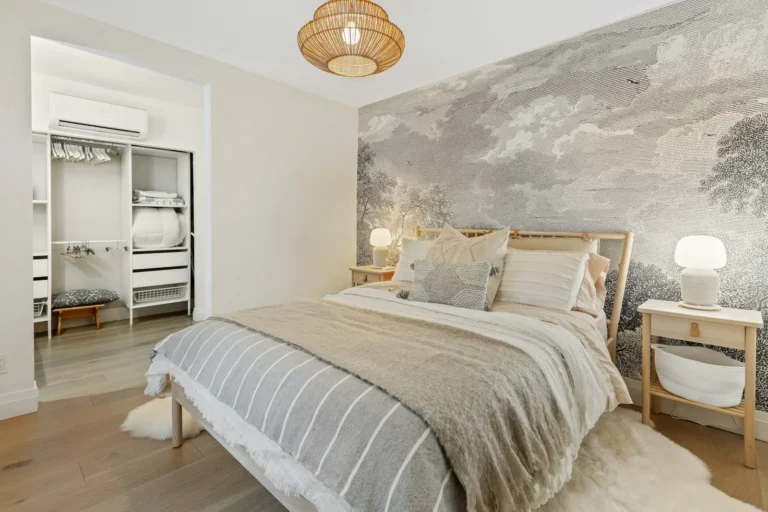
What to watch: a storage frame is heavy and ships flat-packed, so factor in the build and, more important, the future disassembly. This is the piece most likely to take damage on a move. Solid joints and metal brackets survive; all-particleboard cam-lock joints loosen after the second teardown.
What to watch: the budget cube units are particleboard and will sag under heavy books or a TV over time, especially on the open horizontal shelves. Keep the heaviest items in the bottom row, and if you are using it as a media console, check the weight rating against your TV.
What to watch: measure your doorways, stairwell, and the apartment’s tightest turn before ordering any sofa. The classic renter mistake is a couch that fits the room but not the path into it. Reversible-chaise sectionals are friendlier here because they ship in pieces and assemble inside.
What to watch: freestanding is the renter-friendly version here. A wall-mounted headboard means anchors and a patch job at move-out; the freestanding kind just leans against the wall behind the frame and needs nothing. Match it to your bed size before ordering, since a queen headboard on a full bed looks off on both sides.
What to watch: check how the leaves lock and whether the folded depth actually fits where you plan to park it against the wall. A drop-leaf that folds to ten inches lives happily in a hallway; one that folds to eighteen is still in the way.
The one category I would skip
Matching “storage” bedroom or living-room sets sold as a bundle, where the storage is shallow trim drawers in a flimsy particleboard frame. The listing photo shows a coordinated room and the word “storage” in the title, but the actual capacity is a few inches of drawer that holds socks, and the particleboard does not survive one move, let alone the several a renter makes. You pay set-price money for storage that is really just a word in the listing. Buy the individual dual-purpose pieces that hold real volume, an ottoman, a lift-top, a bench, and skip the matching set.
The order to furnish in
If you are starting from an empty room and a tight budget, buy in the order the pieces pay off. The storage ottoman goes first, because it is cheap, it does three jobs, and it absorbs the blanket-and-throw clutter immediately. The lift-top coffee table is next if you work or eat on the couch, since it replaces a second piece of furniture. Then the bedroom: a storage bench at the foot of the bed or, if the budget allows, a storage frame that claims the whole under-bed footprint. The big-ticket storage sofa comes last, once you know the room and the doorways, because it is the piece you least want to get wrong. Everything here cross-references the small apartment storage ideas hub, which maps the storage moves room by room so you are not buying furniture to solve a problem a $15 organizer would have fixed.
The buying checks that separate lasting from landfill
Read the reviews for the moving parts. On a lift-top, a storage bed, or anything with a hinge or a gas strut, the mechanism is what fails first. Search the reviews for “hinge,” “strut,” “wobble,” and “broke” before you buy. The frame can be fine and the lift still quit.
Solid joints over cam-lock particleboard if you move often. Flat-pack furniture held together with cam-lock dowels loosens a little every time you disassemble it. A renter who moves every year or two should weigh metal brackets and solid joints, which survive teardowns, against the cheaper particleboard that is a one-apartment piece.
Match the storage to what is actually overflowing. Hidden storage only pays off if it holds the thing you have too much of. Drowning in blankets means an ottoman; drowning in shoes means a bench; drowning in off-season clothes means a storage bed. Buying storage furniture for storage you do not need is just furniture.
Measure the path, not just the room. The piece has to fit through the door, up the stairwell, and around the tightest turn in the apartment, and then back out again when you leave. For the full no-damage approach to setting up a rental, the renter-friendly decor guide covers the moves that protect your deposit while you make the place yours.
Frequently asked questions about hidden storage furniture
What is the best hidden storage furniture for a small apartment?
A storage ottoman is the best all-around pick because it does the most jobs in the smallest footprint: seating, a surface for a tray, and a hidden bin for blankets. It is also inexpensive and moves easily, which makes it the safest first purchase for a renter furnishing a small space.
Is furniture with built-in storage worth the extra cost?
Usually yes, when you are buying the piece anyway. Paying more for a storage version of a sofa, coffee table, or bed frame gives you back floor space instead of taking it, which is the whole point in a small rental. It is rarely worth buying a piece you do not need just because it has storage.
Does storage furniture hold up to moving?
It depends entirely on the construction. Solid joints and metal brackets survive repeated disassembly; all-particleboard cam-lock joints loosen after the second teardown and the moving parts like lift-top hinges are the first to fail. If you move often, weigh sturdier construction against the cheaper flat-pack that is really a one-apartment piece.
What is an ottoman bed and is it good for renters?
An ottoman bed is a frame whose entire mattress platform lifts on a gas strut to reveal a deep storage cavity underneath. It is excellent for renters because it claims the largest dead space in the bedroom, needs no wall attachment, and opens the whole under-bed footprint in one motion. The main catch is weight and the care it needs on a move.
How do I add storage furniture without damaging my rental?
Choose freestanding pieces, an ottoman, a bench, a storage bed, a freestanding headboard, that sit on the floor and need no drilling or wall mounting. None of them leave a mark to patch at move-out. The only real rule is measuring the doorways and turns so the piece gets in and back out without scraping the walls.
A small rental rewards the furniture that does two jobs in one footprint and quietly punishes the pieces that only do one. Everything else is just furniture paying rent once. For the rest of the apartment, the small apartment storage ideas hub maps every room, and the small bedroom storage ideas guide goes deeper on the under-bed space a storage frame is built to claim.
Get the renter's first-apartment checklist
Small-space decor ideas for renters, straight to your inbox.
The space under your bed is a closet you are not using. 8 renter-friendly under-bed storage picks sorted by clearance and contents, the one to skip, and the measurement to take first.
This post contains affiliate links. If you buy through one I may earn a small commission at no cost to you. You walked into the rental, set the second box of dishes down, and stared at the wall behind where the TV is going. It is the long one, painted contractor-beige, with a faint shadow…
Renters declutter differently: you move every year or two, so the move is your forcing function. A method that works in a small space, plus how to get the stuff out without a car.
A renter-friendly, room-by-room guide to decorating a small apartment without drilling, repainting, or losing the deposit.
Manage Consent
To provide the best experiences, we use technologies like cookies to store and/or access device information. Consenting to these technologies will allow us to process data such as browsing behavior or unique IDs on this site. Not consenting or withdrawing consent, may adversely affect certain features and functions.
Functional
Always active
The technical storage or access is strictly necessary for the legitimate purpose of enabling the use of a specific service explicitly requested by the subscriber or user, or for the sole purpose of carrying out the transmission of a communication over an electronic communications network.
Preferences
The technical storage or access is necessary for the legitimate purpose of storing preferences that are not requested by the subscriber or user.
Statistics
The technical storage or access that is used exclusively for statistical purposes.The technical storage or access that is used exclusively for anonymous statistical purposes. Without a subpoena, voluntary compliance on the part of your Internet Service Provider, or additional records from a third party, information stored or retrieved for this purpose alone cannot usually be used to identify you.
Marketing
The technical storage or access is required to create user profiles to send advertising, or to track the user on a website or across several websites for similar marketing purposes.